Showing posts with label history. Show all posts

Tuesday, 15 October 2013

Day 172 - Interpreting History

Week 36 - Day 172
Whilst work continues within the Chapel another thread of the project continues to put together the story of the Chapel based on documents (what was written down about the Chapel) and on the archaeology of the building (what the fabric of the Chapel tells us about its history). Both of these are incomplete records and have to be evaluated and fitted together in a narrative time-line before we can use it to tell a story.

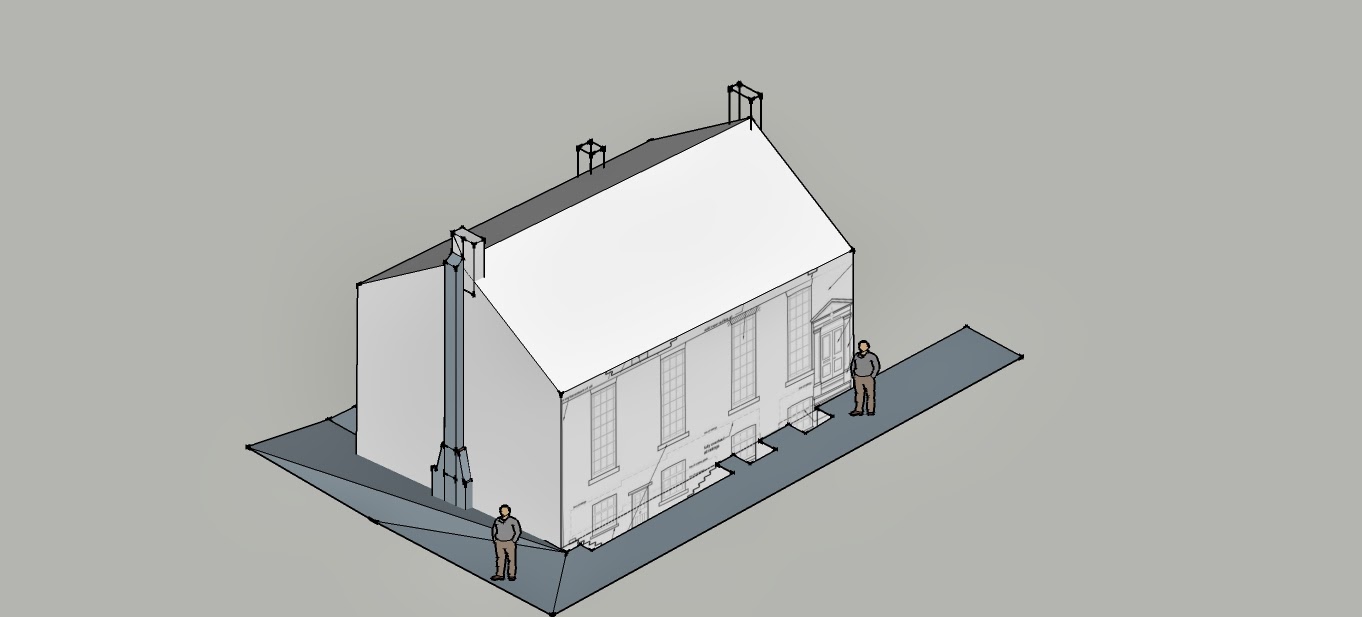
Long section through the chapel showing cellar dwellings
and the chapel itself with its gallery.
In its early arrangement there were no windows in the David Street gable.
A large scale OS map showing the internal pew arrangement around 1845.

Thursday, 6 December 2012

Pipe Organ Research - names associated with maintenance

Our recent dismantling of the pipe organ has uncovered a number of names associated with the building and maintaining of the organ.
We haven't yet discovered who it was originally made for, or where it was used but believe it was relocated to George Street Chapel about 1874.
Keys of the manuals are stamped with both the name of the maker, GW MOORE and the company for whom he worked was R&M DAWSON. The manuals are numbered sequentially 590 and 591.
It seems the original order number may have been 21, which might help with tracking down who made it and for where.

A business card was found which suggests that work was carried out around 1911 by J.P. CROFT, Organ Builder, of 98, Coombrook Street, Manchester (formerly of 66 Oxford Street, Old Trafford, Manchester). Could this be Cornbrook Street?
We have now discovered that JP Croft acted as executor to the will of George Benson, Organ Builder, in 1917 who had premises at 60 Cornbrook Park Road, City Road, Manchester.

A pencil note left on the lead weights over the keys of one of the manuals tells us that the organ was CLEANED & OVERHAULED in FEB 1914 by J. BATH and H. BARLOW.


Roy Lees has already tracked down JP Croft through Census Returns to the address on his card but we have a lot more work to do to associate all the names now linked to the organ.
More information to follow as we uncover it. Or, if you have information that can help, please leave us a message.

Monday, 31 October 2011

1st Independent Methodist Chapel

John Dolan, The Independent Methodists: A History (Cambridge, 2005).

References to George St, Oldham.
p. 24
‘About 1806, a number of worshippers at St Peter’s Church, Oldham, had “been brought to see the necessity and importance of inward religion, to the enjoyment of pardon and, being justified by faith, had peace with God (p. 25) and rejoiced because the love of God was shed abroad in their hearts.” Under the leadership of Joseph Matley, this group held a weekly meeting for Bible reading and Christian fellowship. At one such meeting, a group member, John Nield, took a text and used it as the basis for an exhortation. Matley, a staunch churchman, disapproved, believing that this was the prerogative of the clergyman alone. Some of the group supported Nield and they began to hold meetings in an upper room, later transferring to an old disused mill in Whitehead Street. The incumbent of St Peter’s called upon them to discontinue their meetings but, rather than do so, they separated from the church altogether.
            The dissidents took for themselves the title “Independent Methodists” - and became the first church to use the name which the denomination eventually adopted. In this instance, neither rampant revivalism nor Quaker stillness appears to have been the defining characteristic. By taking the word “Independent” from the world of Old Dissent and linking it with “Methodist” which reflected their spiritual experience, the Oldham people captured better than any of the other formative groups the essence of the movement that was yet to be. Their departing action illustrated the increasing readiness of working people to assert their rights to self-determination and to meet their own spiritual needs, despite the apparent price of sectarian isolation. This would be repeated in numerous towns and villages in the decades ahead. In 1816 the Oldham Independent Methodists built a chapel in George Street and, from this, other churches came in due course and extended their activities into other parts of the town.